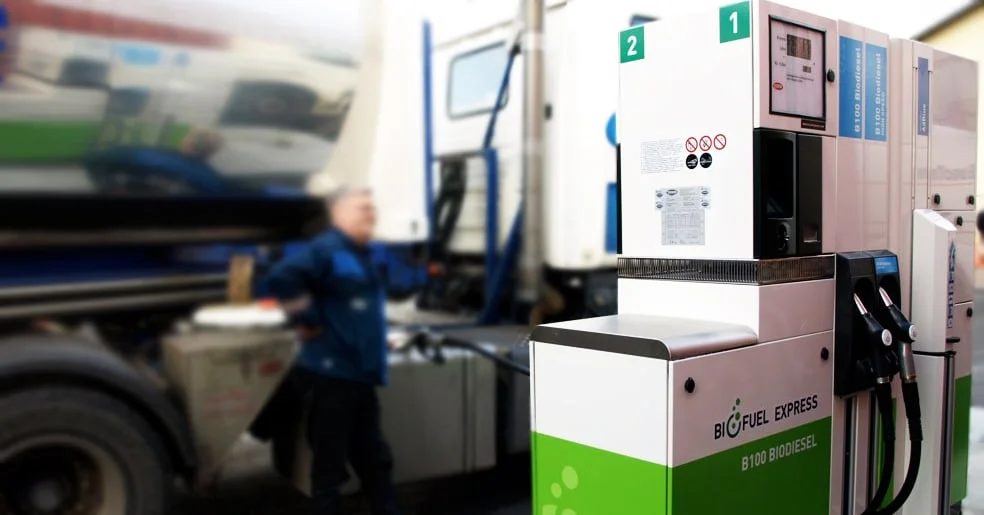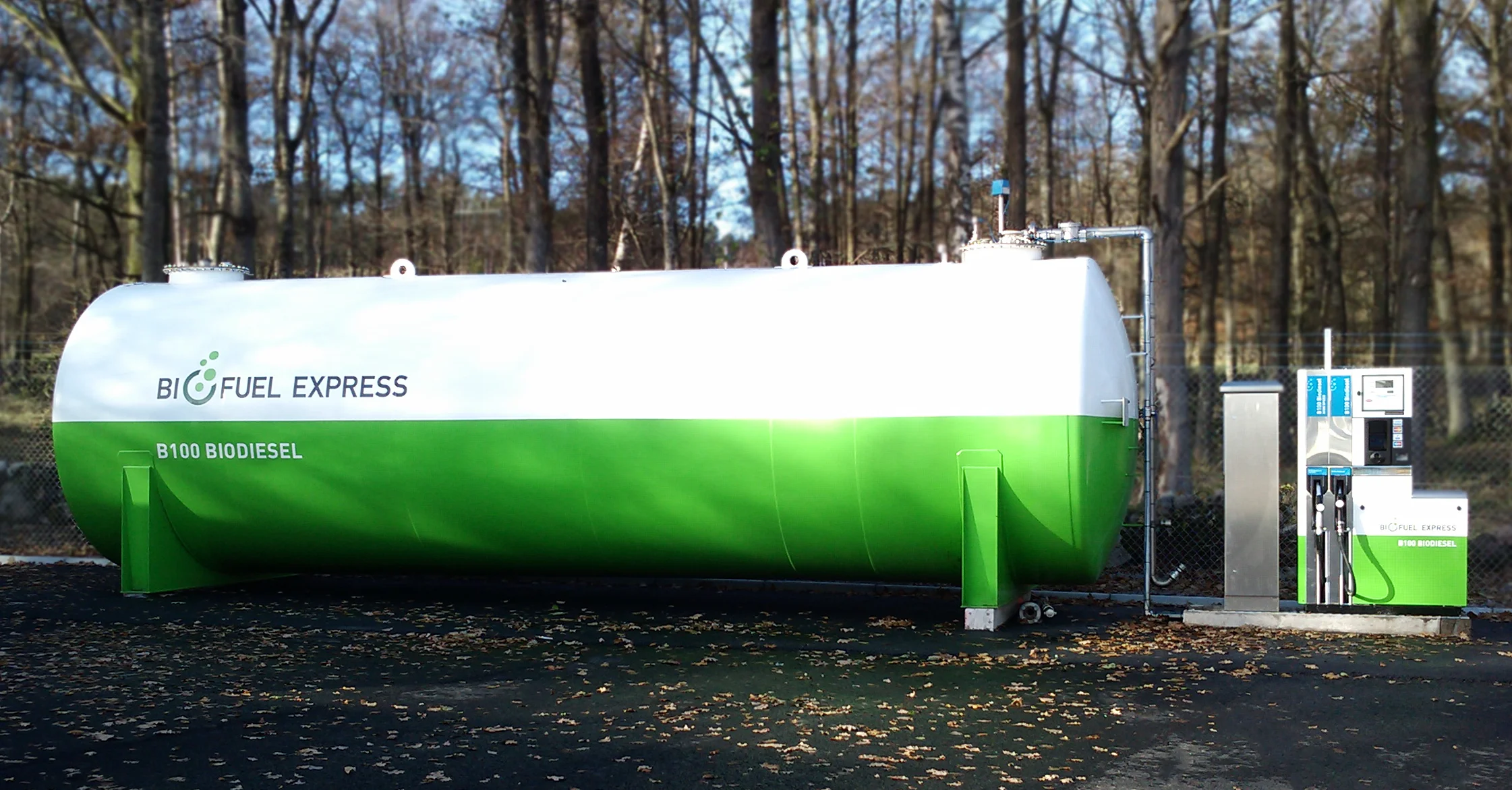







29. Mar 2021

Key Takeaways
- Biodiesel is FAME (Fatty Acid Methyl Ester), made by transesterification – reacting fats or oils with methanol to produce esters plus a glycerol byproduct. In Europe, the dominant form is RME (Rapeseed Methyl Ester), sold at 100% concentration as B100.
- B100 must meet the EN 14214 standard: minimum cetane number 51, minimum 8-hour Rancimat oxidative stability, minimum 96.5% ester content. Above a 7% blend (B7), a vehicle needs specific B100 approval.
- Biofuel Express's B100 delivers up to 67% CO2 reduction compared with fossil diesel** and is usable down to -20°C – a significant improvement over unadditized RME's native cold-flow limit, though still slightly behind HVO100's -22°C.
- Cold-weather performance is B100's one real trade-off against HVO100: base RME has a cold filter plugging point of roughly -4°C before winter-grade blending and cold-flow additives are applied.
- Rapeseed oil is Europe's leading biodiesel feedstock, though EU-wide, waste-based feedstocks (55%) now exceed crop-based feedstocks like rapeseed (38%) across all biodiesel and bioSAF production.
Biodiesel is FAME – Fatty Acid Methyl Ester – a renewable diesel substitute made by chemically converting fats or oils into methyl esters. In Europe, the dominant feedstock is rapeseed oil, so the fuel is most often sold and labelled as RME (Rapeseed Methyl Ester). Sold at full concentration, it's called B100; blended with fossil diesel at lower ratios, it's labelled B7, B10, B20, and so on, by the percentage of biodiesel in the mix (DieselNet, "EU: Biodiesel – Fuels", revision 2024.07, retrieved 2026-08-28).
FAME is a category, not a single product: soy methyl ester, palm methyl ester, and used-cooking-oil methyl ester are all FAME too, made from different feedstocks. RME is simply the specific FAME type that dominates Nordic and European supply, because rapeseed is the region's major oilseed crop. Every litre of B100 sold in the EU, regardless of feedstock, has to meet the same specification: EN 14214, the standard that governs biodiesel's composition, purity, and performance limits – covered in full further down (DieselNet, "EU: Biodiesel – Fuels", retrieved 2026-08-28).
The key facts that define biodiesel/B100/RME:
A common misconception is that "biodiesel" and "HVO100" are interchangeable green-diesel marketing terms. They aren't: both cut lifecycle emissions against fossil diesel, but they're made by entirely different chemical processes, and that difference cascades into blend limits, storage behaviour, and cold-weather performance, all covered in this guide. For the full side-by-side breakdown, see HVO100 Renewable Diesel and B100 Biodiesel (RME) – Do You Know the Differences? Biodiesel also has the longer commercial track record: the EN 14214 standard that governs today's B100/RME was finalised in October 2003, and biodiesel has been sold into European road transport under it ever since, predating HVO100's rise to fleet scale in the 2010s (DieselNet, "Biodiesel Standards & Properties", retrieved 2026-08-28).

The core reason biodiesel matters for fleet operators: it's a renewable, non-toxic, readily biodegradable diesel substitute that cuts lifecycle CO2 emissions without requiring a new vehicle or fuelling infrastructure. Biofuel Express's B100 delivers up to 67% CO2 reduction versus fossil diesel**, a figure covered in full further down this guide, and it runs in any engine specifically approved for B100 with no conversion kit required.
Biodiesel's environmental profile goes beyond the CO2 figure. Unlike fossil diesel, FAME is readily biodegradable and far less toxic if spilled, which matters for operators working near waterways, forestry sites, or environmentally sensitive terrain. Combustion also produces lower particulate and sulfur output than fossil diesel, since FAME itself is essentially sulfur-free by the nature of its feedstock.
Regulatory pressure adds urgency. Sweden's greenhouse gas reduction mandate (reduktionsplikt) was raised back to 10% for both diesel and petrol from July 2025, after a temporary cut, and Germany has moved in 2026 to ease tax treatment for agricultural biofuel use – both signals that policymakers across the region continue to lean on biodiesel and renewable diesel together, not as a fading first-generation technology (Argus Media, Swedish mandate coverage, retrieved 2026-08-28; Biofuels International, UFOP tax exemption coverage, 2026-05-07).
For fleets specifically, ignoring this shift carries a real cost: tender criteria increasingly weight documented emissions reductions, and corporate customers expect Scope 3 reporting from logistics providers. Fuel security matters too – biodiesel produced from regionally grown rapeseed or collected waste oils reduces dependence on imported crude. Getting biodiesel right starts with understanding its chemistry, its EN 14214 properties, and where it fits against HVO100 – covered next.
Biodiesel is made by transesterification: a chemical reaction that combines a fat or oil (a triglyceride) with a short-chain alcohol, almost always methanol, in the presence of a catalyst. The reaction breaks the triglyceride apart and reattaches its fatty-acid chains to methanol molecules, producing fatty acid methyl esters – FAME, the biodiesel itself – along with glycerol as a byproduct (standard organic-chemistry process, corroborated by DieselNet, "Biodiesel – Mono Alkyl Esters", revision 2026.03).
This is a fundamentally different chemical route from how HVO100 is produced. HVO100 is made by hydrotreatment: reacting the same kind of fat and oil feedstocks with hydrogen under heat and pressure, which strips out oxygen entirely and produces straight-chain paraffinic hydrocarbons instead of esters. Transesterification keeps the oxygen; hydrotreatment removes it – and that single difference drives the blend limits, storage stability, and cold-weather behaviour covered later in this guide.
The practical consequence: because FAME retains oxygen and residual double bonds, it's inherently more reactive than HVO100's saturated hydrocarbons. That reactivity is precisely why EN 14214 sets a minimum oxidative stability requirement that doesn't apply to HVO100 at all, covered two sections down. For the complete technical comparison between the two production routes, see HVO100 Renewable Diesel and B100 Biodiesel (RME) – Do You Know the Differences?
A common mistake is assuming "renewable diesel" is a single category with one set of rules. It isn't: biodiesel and HVO100 sit under different European standards (EN 14214 and EN 15940) precisely because they're chemically distinct fuels made by different processes. For lesser-known technical facts about how biodiesel is refined, certified, and used, see Seven Things You Probably Don't Know About Biodiesel.
Rapeseed oil is the leading European feedstock for biodiesel, which is why the fuel is most commonly sold in this region as RME rather than under a generic "biodiesel" label. In Germany specifically, rapeseed-based biodiesel accounted for roughly 53.1% of total biodiesel output in 2024, drawing on around 1.45 million tonnes of processed rapeseed oil (Biofuels International, citing VDB and UFOP data, published 2025-05-09).
The broader EU picture is shifting, though. Across the EU-27, waste-based feedstocks – used cooking oil, animal-fat residues, and other Annex IX materials – now account for 55% of total biodiesel and bioSAF (sustainable aviation fuel) production, ahead of crop-based feedstocks like rapeseed at 38% (European Biodiesel Board, Statistical Report 2025-2026, published June 2026). Rapeseed remains the dominant feedstock within the crop-based category specifically; it just no longer represents the majority of all biodiesel production EU-wide the way it once did.
Beyond rapeseed, biodiesel can also be produced from used cooking oil and animal-fat residues – the same waste-stream categories that feed HVO100 production, just routed through transesterification instead of hydrotreatment. Waste-based FAME carries a sustainability advantage under RED III's feedstock rules, covered in the policy section below, since it isn't subject to the crop-based feedstock cap that applies to rapeseed RME.

For a closer look at rapeseed's role as Europe's leading biodiesel crop – from field to fuel tank – see Rapeseed: The Yellow and Green Gold.
Every litre of B100 or RME sold in Europe has to meet EN 14214, the standard that sets biodiesel's composition and performance limits – and it's the standard this section exists to explain in full, since the answer to "what is B100 biodiesel RME made of and which properties does it have" starts here.
The headline EN 14214 specification limits, as directly published by DieselNet's standards reference:
(All figures: DieselNet, "EU: Biodiesel – Fuels," Table 1, revision 2024.07, retrieved 2026-08-28.)
The table below places B100/RME's EN 14214 properties directly alongside HVO100 (EN 15940) and fossil diesel (EN 590), the comparison this section – and the query it now answers – exists to make explicit.
| Property | FAME Biodiesel (EN 14214) | HVO100 (EN 15940) | Fossil Diesel (EN 590) |
|---|---|---|---|
| Minimum ester/paraffin purity | 96.5% FAME content (m/m) | n/a (paraffinic hydrocarbon, not ester-based) | n/a (base fuel) |
| Minimum cetane number | 51.0 | >70 (Class A) | 51 |
| Minimum oxidative stability (Rancimat) | 8.0 hours | No FAME-style oxidation limit (no oxygen/double bonds) | n/a |
| Maximum iodine value | 120 g iodine/100 g | n/a | n/a |
| Blend limit in standard diesel engines | Up to 7% (B7) without a B100-approved vehicle | Up to 100% | n/a (base fuel) |
| Lowest reliable operating temperature | -4°C base RME (unadditized); -20°C Biofuel Express winter-grade B100 | -22°C (Biofuel Express product data) | ≈-20°C with cold-flow additives |
| Engine modification required | None up to B7; B100 requires an approved vehicle | None for approved diesel engines | n/a (base fuel) |
Sources: DieselNet, "EU: Biodiesel – Fuels"; IEA Advanced Motor Fuels, "Fatty Acid Esters – Fuel Properties" (both accessed 2026); Biofuel Express product data for the B100 and HVO100 cold-weather figures. HVO100/EN 590 columns corroborate the HVO100 guide's own comparison table.
The Rancimat oxidative-stability requirement is the property that most differentiates biodiesel handling from HVO100. Because FAME contains oxygen and unsaturated bonds, it's inherently more reactive with air over time than a purely paraffinic fuel; the 8-hour minimum exists to guarantee that a batch of properly produced B100 won't degrade into gums, sediment, or acids during normal storage and delivery windows. In practice, biodiesel has a shorter recommended storage life than HVO100 and benefits from more turnover discipline.
Blend limits follow directly from the standard architecture. EN 590 (the fossil-diesel standard) permits blending with FAME up to 7% by volume – the B7 grade sold at most filling stations – without requiring any special vehicle approval. Beyond that, EN 16734 covers up to 10% FAME and EN 16709 covers higher intermediate blends, but running B100 at full concentration requires a vehicle specifically approved for it, covered in the engine-compatibility section below (DieselNet, "EU: Biodiesel – Fuels", retrieved 2026-08-28).
A lot of misinformation circulates around what these properties actually mean for day-to-day operation – whether B100 damages seals, whether it "goes off" quickly, whether it's compatible with modern common-rail injection systems. For a myth-by-myth breakdown of biodiesel's operational properties, see Myths About Biodiesel's Operational Properties: What Is True and What Is False.
Cold-weather behaviour is the one area where biodiesel is genuinely at a disadvantage against HVO100, and a supplier that glosses over it isn't giving you the full picture. Base, unadditized rapeseed methyl ester has a cold filter plugging point (CFPP) – the temperature at which wax crystals start blocking fuel filters – of roughly -4°C, well within the range of an ordinary Nordic autumn night, let alone a winter month (IEA Advanced Motor Fuels, "Fatty Acid Esters – Fuel Properties", retrieved 2026-08-28).
IEA-AMF's Annex 10 research found that real-world cold-start performance worsened by roughly 4°C when 20% RME was blended into diesel – a degradation the standard CFPP test doesn't fully capture (same source). In practical terms: base RME's cold-weather limitation is real and feedstock-driven, not just a spec-sheet technicality.
That's why winter-grade blending and cold-flow additives exist, and why they matter. Biofuel Express's B100 is formulated and verified usable down to -20°C, a substantial improvement over base RME's native -4°C CFPP, achieved through winter-grade blending and cold-flow additive treatment rather than a change to the underlying EN 14214 chemistry. That's still a narrower margin than HVO100, which Biofuel Express verifies usable down to -22°C thanks to its paraffinic chemistry allowing direct control over wax-forming components during refining – see What Is HVO100? The Complete Guide for Fleet Operators for the full technical explanation of why HVO100's cold-flow ceiling runs slightly higher.
The practical takeaway: B100 is a genuinely capable winter fuel when sourced as a properly formulated, winter-grade product rather than a generic commodity – but operators running the coldest routes in northern Sweden or Norway may still find HVO100 the more conservative choice, while B100 remains strong for the large majority of Nordic and Central European routes where -20°C coverage is sufficient.
The EU's Renewable Energy Directive III (RED III) sets the framework that determines whether biodiesel counts towards a country's or company's renewable-transport targets – the same framework already covered in depth in Biofuel Express's HVO100 guide, so this section focuses on the one rule that applies differently to B100/RME than it does to HVO100.
RED III continues a cap, first introduced under RED II, that limits food- and feed-crop-based biofuels – including rapeseed RME – to a maximum of 7% of a member state's road-and-rail transport energy (or the country's 2020 consumption level plus 1%, whichever is lower) (DieselNet, "EU: Renewable Transportation Fuel Policies", retrieved 2026-08-28). That cap exists because crop-based biofuels carry indirect land-use-change (ILUC) risk – the concern that diverting cropland to fuel production can indirectly push agricultural expansion elsewhere. It's the single biggest structural difference between how RED III treats rapeseed RME and how it treats HVO100's typical waste-based feedstocks, which face no equivalent cap and additionally count double towards advanced-biofuel sub-targets.
The 7% cap governs national blending mandates and target accounting, not whether an individual fleet can buy and use B100 – but it does mean feedstock transparency matters when evaluating a supplier's sustainability claims, since waste-oil-derived FAME carries a different regulatory profile than straight rapeseed RME, even though both meet the same EN 14214 standard.
National tax policy adds another layer. Sweden and other Nordic markets have periodically extended tax exemptions for pure biofuels like B100 and HVO100, treatment that materially affects the total cost of switching a fleet over from fossil diesel. For current details, see Another Year of Tax Exemption for B100 and HVO100.
Ethical and climate questions around biodiesel – land use, food-versus-fuel debates, and whether crop-based fuels genuinely reduce emissions once the full supply chain is accounted for – are legitimate topics that deserve a direct answer rather than a dismissal. For the full breakdown of what's substantiated and what isn't, see Myths About Biodiesel's Ethical and Climate Challenges: What Is True and What Is False.
B100 requires a vehicle specifically approved for 100% biodiesel operation – unlike HVO100, which runs in any diesel engine already approved for EN 15940 fuel with no modification. That approval requirement is the direct consequence of EN 14214's blend-limit architecture covered earlier: EN 590 only covers fossil diesel blended with up to 7% FAME, so running neat B100 falls outside a standard diesel engine's factory specification unless the manufacturer has issued a B100-specific approval.
Major OEMs have issued exactly that. Scania has approved B100/RME operation on a wide range of its engines, extending FAME compatibility with dedicated adaptation packages across Euro III through Euro VI generations, and separately approved 100% biodiesel operation on its Euro 6 engine range starting in the mid-2010s (AGQM, "Scania B10/B100 Approvals", page dated February 2024; corroborated by Biomass Magazine, Scania renewable diesel approval coverage). Scania has continued investing in RME-specific powertrain development since, including a newer RME-optimised engine platform aimed at reducing fuel consumption on B100 specifically – see Scania Launches New RME Powertrain, Which Reduces Fuel Consumption.
The practical step for any fleet considering B100: confirm approval status model by model, rather than assuming blanket compatibility across a mixed fleet. Running B100 in an unapproved vehicle can affect warranty coverage and seal or fuel-system durability over time. For a current overview of which vehicles carry B100/RME approval, see Get an Overview of Approved Vehicles for B100 Biodiesel (RME) Premium.
Biofuel Express's B100 delivers up to 67% CO2 reduction compared with fossil diesel** on a lifecycle basis – company product data reflecting our own fuel's feedstock mix and supply chain, not a third-party industry average. That figure sits below HVO100's up to 86% reduction* (see What Is HVO100? for that fuel's full CO2 methodology), a gap that traces back to feedstock and production-chemistry differences between transesterification and hydrotreatment rather than to any single production defect in either fuel.
* Based on 2025 verified delivery data. Actual reduction per delivery ranges from 57% to 121% depending on feedstock composition and certified batch. Calculated per the RED III well-to-wheel life-cycle methodology using ISCC-certified mass balance allocation. Proof of Sustainability (PoS) documentation available on request.
** Based on 2025 verified delivery data. Actual reduction per delivery ranges from 57% to 67% depending on feedstock composition and certified batch. Calculated per the RED III well-to-wheel life-cycle methodology using ISCC-certified mass balance allocation. Proof of Sustainability (PoS) documentation available on request.
The business case follows the same shape as HVO100's: no capital expenditure for already-approved vehicles, a documented emissions reduction for tenders and Scope 3 reporting, and a fuel-security benefit from sourcing regionally produced or waste-derived feedstock rather than imported crude. B100's engine-longevity profile is a genuine, if less-discussed, part of the case too: FAME's lubricity is excellent, and as little as 1-2% biodiesel blended into ultra-low-sulfur diesel restores the lubricity that sulfur removal strips out, which is why FAME blends are widely used specifically to protect fuel pumps and injectors from wear (IEA Advanced Motor Fuels, "Fatty Acid Esters – Fuel Properties", retrieved 2026-08-28).
Where B100's business case differs from HVO100's is the vehicle-approval requirement covered above: switching means confirming, and where necessary budgeting for, approved vehicles rather than a universal drop-in swap. Mixed fleets often run B100 on the approved portion and HVO100 or B7 on the rest, rather than standardising on one fuel. Price and tax treatment vary by market and shift with policy, so ask a supplier for current, market-specific figures rather than budgeting off a general number – see the tax exemption update referenced earlier. For the broader business case for switching – ROI, compliance, and competitive positioning – see This Is Why Your Company Needs Renewable Fuels.
B100's non-toxic, readily biodegradable profile makes it a particularly strong fit for applications where fuel spills carry outsized environmental risk – forestry operations, marine use, and construction sites working near soil or water. Construction machinery is one of the more visible B100 use cases in the Nordic market, since off-road diesel equipment often operates for extended periods in a single location, where biodiesel's rapid biodegradability (it's classified readily biodegradable under REACH) meaningfully reduces the consequence of an on-site leak or spill.

Beyond the environmental case, construction fleets get the same emissions-reduction and tax advantages covered above, and B100's approved-vehicle requirement is less of an obstacle here, since much construction equipment is already sourced through fleet contracts where B100 approval can be specified up front. For a detailed look at equipment selection, storage handling, and the environmental case in practice, see How Can B100 Biodiesel (RME) Be Used Effectively in the Construction Industry for the Benefit of the Environment and Climate?
Biodiesel has accumulated more misinformation than most renewable fuels, partly because it does carry real handling considerations – cold-flow limits and oxidative degradation in storage, both covered earlier in this guide – that a properly specified, EN 14214-compliant B100 substantially addresses (DieselNet, "Low Temperature Operability of Biodiesel", revision 2023.05, retrieved 2026-08-28). Two categories of myth persist and are worth separating.
Operational myths – claims about whether B100 damages engines, degrades too quickly to be practical, or performs unpredictably in modern common-rail systems – are addressed point by point, with the EN 14214 evidence behind each answer, in Myths About Biodiesel's Operational Properties: What Is True and What Is False.
Ethical and climate myths – claims about land use, food-versus-fuel tradeoffs, and whether crop-based biodiesel's climate benefit is overstated – deserve a direct, sourced answer rather than either dismissal or uncritical acceptance, covered in Myths About Biodiesel's Ethical and Climate Challenges: What Is True and What Is False.
The short version: modern B100 that meets EN 14214, sourced from a supplier transparent about feedstock and certification, does not carry the operational risks of decades-old biodiesel blends, and its climate case – more nuanced than HVO100's waste-feedstock story, given the RED III crop cap covered earlier – remains a genuine, documented emissions reduction versus fossil diesel.
Before signing a B100 supply agreement, confirm four things: current sustainability certification (ISCC or REDcert) and the GHG-savings figure it documents; feedstock transparency (rapeseed RME vs. waste-oil-derived FAME, given the RED III treatment difference above); winter-grade formulation and cold-flow additive treatment suited to your routes, not a generic unadditized product; and confirmation the fuel meets EN 14214 in full, with test data on request.
Biofuel Express supplies certified B100 biodiesel (RME) to fleet operators across Sweden, Denmark, Norway, Germany, and Austria, with the CO2-reduction and cold-weather performance figures cited throughout this guide reflecting our own product's specifications. Fleet operators ready to move from research to a delivery quote can review current specifications, delivery areas, and ordering details on the B100 Biodiesel (RME) Premium product page, or contact our team directly with questions specific to your fleet and routes.
B100 stands for 100% biodiesel – neat FAME (Fatty Acid Methyl Ester) used at full concentration, without blending it into fossil diesel. Lower blend ratios are labelled by their biodiesel percentage: B7 (7% biodiesel, the standard pump-diesel blend limit under EN 590), B10, B20, and so on.
RME (Rapeseed Methyl Ester) is made by transesterification: reacting rapeseed oil with methanol in the presence of a catalyst, which produces fatty acid methyl esters (the fuel itself) plus glycerol as a byproduct. It's the specific FAME variant that dominates European and Nordic biodiesel supply because rapeseed is the region's major oilseed crop.
No. Both are renewable diesel substitutes, but biodiesel (FAME/B100/RME) is made by transesterification and HVO100 by hydrotreatment, producing chemically different fuels with different blend limits, storage stability, and cold-weather performance. See the dedicated HVO100 vs. biodiesel comparison for the full breakdown.
No, not above the B7 blend limit. EN 590 covers fossil diesel blended with up to 7% FAME without requiring special approval; running B100 at full concentration requires a vehicle the manufacturer has specifically approved for it. Scania has approved B100/RME operation across a range of its engine generations – confirm your specific model's approval status before switching.
Biofuel Express's B100 delivers up to 67% CO2 reduction compared with fossil diesel** on a lifecycle basis – company product data reflecting our own feedstock mix and supply chain. The exact figure for any biodiesel product depends on its specific feedstock and production chain.
With qualification. Base, unadditized rapeseed methyl ester has a cold filter plugging point around -4°C, a real limitation for Nordic winters. Biofuel Express's winter-grade B100 is formulated with cold-flow additives and verified usable down to -20°C, closing most of that gap, though it remains slightly behind HVO100's -22°C. Fleets running the coldest routes should discuss winter-grade specification directly with their supplier.
Yes. FAME is readily biodegradable — confirmed by Biofuel Express's own REACH Safety Data Sheet — and substantially less toxic than fossil diesel if spilled, which is one reason it's a preferred choice for construction, forestry, and marine applications where spill risk near soil or water is a genuine operational concern.
Biodiesel – sold as B100 or RME – is FAME made by transesterification, built to the EN 14214 standard, and capable of up to 67% CO2 reduction against fossil diesel** in Biofuel Express's own product. It's chemically distinct from HVO100, requires an approved vehicle above a B7 blend, and carries a real, honestly-stated cold-weather trade-off against HVO100's paraffinic chemistry – but for the large majority of Nordic and Central European routes, a properly sourced, winter-grade B100 is a proven, non-toxic, readily biodegradable fossil-diesel replacement with a standardised track record stretching back to 2003.
The path from here: confirm your fleet's B100 vehicle approvals, ask your supplier for EN 14214 test data and feedstock transparency, and specify winter-grade formulation for any routes running through a full Nordic winter. Every article linked throughout this guide goes deeper into one piece of that process.
Fundamentals:
Myths, Addressed:
Comparisons:
Applications and Policy:
Get a Quote:
"*" indicates required fields