24. Jun 2026
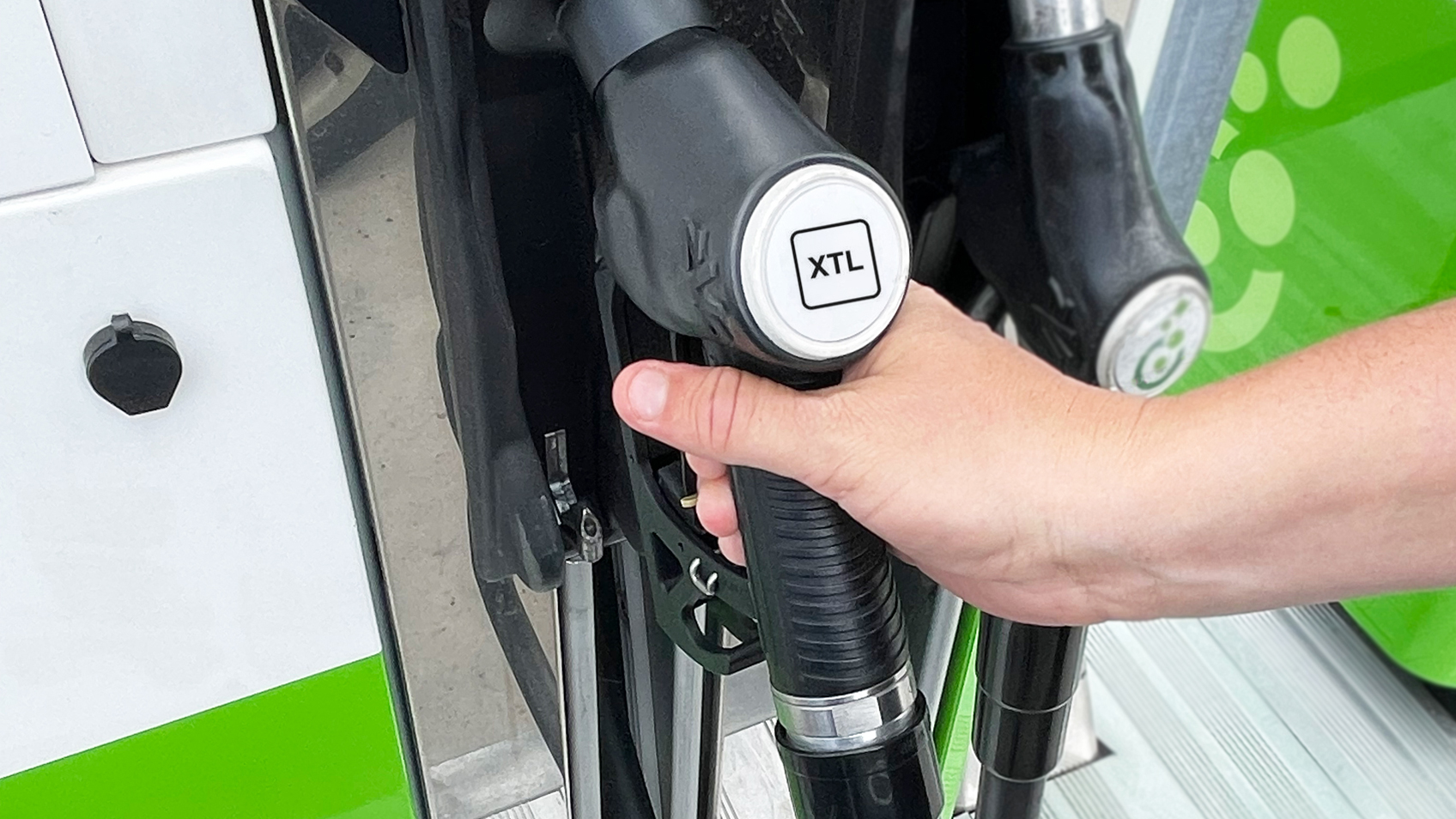
"XTL" now appears on fuel pumps across Europe, and on the filler caps of more and more trucks and vans. For a fleet operator thinking about HVO100, that small label is the quickest answer to the question that matters most: can this vehicle run on it? This guide explains what the XTL label means, what the EN 15940 standard behind it covers, what the major truck and van manufacturers say about HVO100 – and how to check a whole fleet properly before you switch.
Key Takeaways: If your vehicle has an "XTL" label next to the filler cap or in its manual, the manufacturer has confirmed it for paraffinic diesel to EN 15940 – which is what HVO100 is. EU rules require that label on compatible vehicles and on every pump selling the fuel. Most major truck and van manufacturers have approved HVO for a wide range of engines, but approvals differ by engine and model year – so check the label, the manual or your dealer (by chassis number) before switching, and keep the confirmation on file.
Can your vehicle run on HVO100? If there is an "XTL" label next to the filler cap or in the vehicle manual, yes – the manufacturer has confirmed the vehicle for that fuel. If there is no label, the vehicle may still be approved, but you need to check with the manufacturer.
The label is not a marketing sticker. Under the EU's Alternative Fuels Infrastructure Regulation (AFIR), fuel compatibility has to be shown in the same way in two places (Regulation (EU) 2023/1804, Article 19(2)):
The labels themselves follow the European standard EN 16942 (AFIR, Annex II, point 10.1). In that labelling system, XTL is the identifier for paraffinic diesel – fuel that "may originate from synthesis or hydrotreatment processes" and whose quality is described in EN 15940 (CEN-CENELEC, Fuel labels). HVO100 is a hydrotreated paraffinic diesel, so an XTL pump sells it and an XTL vehicle accepts it.
One limitation: the label requirement applies when vehicles are placed on the market, so an older truck or van without the label is not automatically excluded. For those, the manufacturer's approval list or your dealer is the source – see what the manufacturers say below.
EN 15940 is the European standard for paraffinic diesel fuel made by synthesis or hydrotreatment. HVO100 is produced and sold to this standard – "XTL" is the name on the label, "HVO100" the name most people use.
The full title is Automotive fuels – Paraffinic diesel fuel from synthesis or hydrotreatment – Requirements and test methods. The current edition is EN 15940:2023, published in May 2023; it replaced the earlier EN 15940:2016+A1:2018 editions (SNV, SN EN 15940:2023). Key points from its scope (EVS, EVS-EN 15940:2023):
That last sentence is the standard itself telling you to check with the manufacturer – which is why the XTL label and the manufacturers' approval lists matter.
Ordinary pump diesel follows a different standard, EN 590, which also allows up to 7% FAME – the "B7" on the pump. In Germany, the rules are written into law: paraffinic diesel of the quality "XTL" may only be sold to end users if it meets DIN EN 15940, July 2023 edition (10. BImSchV, § 4(3)).
Biofuel Express's HVO100 is specified to EN 15940 (and ASTM D975), with a cetane number of at least 70, a density of 770–790 kg/m³ at 15 °C, and no FAME added (Biofuel Express HVO100 product data sheet, December 2025 – available on request).
In an approved engine, HVO100 is used like diesel: no conversion, the same tanks and the same refuelling routine. The main practical difference is that a litre of HVO100 carries slightly less energy than a litre of B7 diesel, so the same work takes around 3% more litres.
The energy content of HVO100 is 34 MJ per litre against 35 MJ for diesel B7 – the figures we use in how to calculate CO2 emissions from diesel and HVO100. Keep that in mind when you compare fuel volumes before and after a switch.
Manufacturers that have approved HVO describe it the same way:
For a step-by-step switch plan, see From Diesel to HVO100 Without Disruption.
Most major truck and van manufacturers have approved HVO for a wide range of engines – many of them years ago. But the wording, the dates and the engines covered differ, so always confirm for your specific vehicles.
Approvals refer to the fuel standard (EN 15940), not to a fuel brand. The table combines two kinds of source: the manufacturer's own statement where one is published, and the OEM approvals list compiled by our partner Neste, one of the largest producers of HVO, which collects manufacturers' approvals for its EN 15940 fuel (Neste, OEM approvals, accessed 27 October 2026). Neste notes that it updates the list regularly but that you "should always check with your manufacturer for current approval status".
Trucks and buses
| Manufacturer | What is covered | Source |
|---|---|---|
| Scania | All Euro 6 trucks and buses, provided the fuel meets (T)S 15940; all Euro 5 vehicles approved earlier the same year | Scania, 8 October 2015 |
| Volvo Trucks | All Euro 5 engines, unchanged service intervals; Euro 6 certification under EN 15940 announced in 2015. The new D13 engine platform is "ready for" HVO | Volvo Trucks, 22 June 2015 and 12 May 2026; Neste list: all heavy commercial vehicles |
| Renault Trucks | All heavy commercial vehicles (2008); the new DE13 R powertrain for the T, T High, C and K ranges is "compatible with HVO" | Neste list; Renault Trucks (MY2027 powertrain) |
| DAF | All heavy commercial vehicles; PACCAR MX-11 and MX-13 bus and coach engines "run perfectly on HVO" | Neste list; DAF, 29 September 2025 |
| Mercedes-Benz | OM934, OM936, OM470, OM471, OM473 engines (01.2013) | Neste list |
| MAN | D0834, D0836, D1556, D2066, D2676, D3876 engines (2016) | Neste list |
| IVECO | Tector 8, Cursor 9, Cursor 10, Cursor 13 and NEF engines (2017) | Neste list |
Vans and light commercial vehicles
| Manufacturer | What is covered | Source |
|---|---|---|
| Mercedes-Benz | Sprinter OM651 (10.2016), Sprinter MR6 (10.2019), Vito (10.2016), Citan (11.2018) | Neste list |
| Volkswagen | Caddy, Crafter and T-series with 4-cylinder engines (06.2021); vehicles over 3.5 tonnes gross weight (2016) | Neste list |
| Ford | Transit, Transit Custom and Ranger 2.0 EcoBlue (05.2019); Transit Connect 1.5 EcoBlue (05.2019); Transit Courier (11.2020) | Neste list |
| IVECO | Daily 3.5–7.0 t (2020) | Neste list |
| MAN | TGE (2016) | Neste list |
| Renault | Trafic, Master, Kangoo (03.2019) | Neste list |
| Peugeot, Citroën | All diesel light commercial vehicles (01.2011) | Neste list |
| Toyota | Proace, Proace Verso (2014) | Neste list |
Machinery and other engines: MAN Engines has approved its off-road and marine engines for HVO100 or any blend (MAN Engines, 2023), and Volvo Penta has approved HVO, neat or blended, in all its diesel engines (Volvo Group, 21 April 2016). Neste's list also covers non-road machinery from several other manufacturers.
Neste list = Neste, OEM approvals, accessed 27 October 2026; dates in brackets are the approval dates given there. Manufacturer statements link to the manufacturer's own release.
Two things to read into the wording. First, "approved", "compatible" and "ready for" are not the same: a formal approval under EN 15940 is what you want in writing. Second, several approvals date from 2015–2017 and have not been republished since. They still stand as the manufacturers' published positions, but engine generations have changed – which is why a check by chassis number is worth the few minutes it takes.
For B100 biodiesel, see our separate overview of approved vehicles for B100.
Yes – the manufacturers that address it allow HVO100 and diesel to be mixed freely, so you can switch without emptying the tank first. If your manufacturer's approval doesn't mention mixing, ask.
Volvo Trucks states that "it is also possible to freely mix diesel and HVO" (Volvo Trucks, 2015). MAN Engines approves HVO100 "or with an admixture – at any mixing ratio – of conventional diesel fuel" (MAN Engines, 2023), and Volvo Penta approves HVO "neat or blended with conventional diesel" (Volvo Group, 2016).
That also means a truck that sometimes has to refuel with B7 on the road can go straight back to HVO100 at the next fill.
Using HVO100 in an engine the manufacturer has approved for EN 15940 fuel keeps you within the manufacturer's fuel specification. Using it in an engine that is not approved can put warranty claims at risk – so get the approval for your vehicles in writing.
The standard says so directly: "for general diesel engine warranty, the vehicle manufacturer needs to be consulted before use" (EVS-EN 15940:2023). Neste's approval guidance adds that warranty coverage "may be denied if you use a fuel that is not approved by the OEM manufacturer and you encounter a problem that can be definitively traced to the fuel" (Neste, OEM approvals).
In practice: if the XTL label is on the vehicle, or the engine appears in the manufacturer's approval, keep a copy of that evidence with the vehicle's documents. If it doesn't, ask the dealer to confirm in writing before you switch.
For a mixed fleet, a short check per vehicle avoids surprises later. Work through it once, keep the results, and you have a record for every vehicle you move to HVO100.
Running a mixed fleet and not sure where to start? Contact us – we can help you map which vehicles are ready for HVO100.
Most likely, if it has a modern diesel engine from a major manufacturer: Scania, Volvo Trucks, Renault Trucks and DAF have published HVO approvals or compatibility statements, and Neste's OEM approvals list includes engines from Mercedes-Benz, MAN and IVECO as well. Check the XTL label next to the filler cap or in the manual; if there is none, confirm with your dealer by chassis number.
Many vans are approved – for example the Mercedes-Benz Sprinter and Vito, Volkswagen Crafter and Caddy, Ford Transit and Transit Custom, IVECO Daily and Renault Master, according to Neste's OEM approvals list. Approval often depends on the engine and model year, so look for the XTL label or check with the dealer.
XTL is the EU fuel label for paraffinic diesel made by synthesis or hydrotreatment to EN 15940 – which includes HVO100. A vehicle with the same XTL label at its filler cap is confirmed by its manufacturer for that fuel.
Not if the manufacturer has approved the engine for EN 15940 fuel. If it hasn't, a problem traced to the fuel may not be covered. Keep the approval – the label, the manual entry or a written dealer confirmation – on file.
Not for approved engines, according to the manufacturers' statements: Volvo Trucks approved HVO with unchanged service intervals, Scania states that HVO does not affect maintenance requirements, and MAN Engines and Volvo Penta require no modifications. Follow your manufacturer's service schedule as usual.
Ready to move your fleet to HVO100? Talk to us.
"*" indicates required fields