24. Jun 2026

RED II and RED III represent significant steps in Europe’s journey toward a fossil-free future. For businesses in the transport sector, these directives are not just regulatory obligations – they are opportunities to reduce emissions and future-proof operations.
By adopting renewable fuels like HVO and leveraging partnerships with experts like Biofuel Express, businesses can meet the ambitious goals set by RED while maintaining operational efficiency.
First introduced in 2009, the Renewable Energy Directive set binding targets for renewable energy use across the EU. Its primary goal was to increase the share of renewables in the energy mix, reducing dependency on fossil fuels and cutting greenhouse gas emissions.
RED II: A Focus on 2030 Goals
RED II, adopted in 2018, outlines ambitious objectives for integrating renewable energy across all sectors, with a significant focus on transport. One of its primary goals is to ensure that at least 32% of the EU’s total energy consumption comes from renewable sources by 2030.
In the transport sector, RED II mandates that renewable energy must account for at least 14% of total transport energy consumption by 2030. To achieve this, the directive promotes the use of advanced biofuels, which are derived from waste and residues rather than food crops.
Additionally, RED II sets sustainability and greenhouse gas (GHG) savings criteria for biofuels, bioliquids and biomass fuels. For biofuels used in transport, the GHG saving must be at least 50%, 60% or 65% compared with fossil fuel, depending on when the production plant started operating.

RED III: Higher Targets for 2030
RED III (Directive (EU) 2023/2413) was adopted in October 2023, and Member States had to write it into national law by 21 May 2025. It is part of the Fit for 55 package, which aims to reduce greenhouse gas emissions by 55% by 2030, and raises the EU’s overall renewable energy target to at least 42.5% by 2030. For transport, each Member State must oblige fuel suppliers to reach either a renewable energy share of at least 29% or a greenhouse gas intensity reduction of at least 14.5% by 2030. On top of that comes a combined sub-target for advanced biofuels and renewable fuels of non-biological origin: at least 1% in 2025 and 5.5% in 2030.
Another key component of RED III is the promotion of hydrogen and e-fuels: at least 1 percentage point of the 2030 sub-target must come from renewable fuels of non-biological origin, such as renewable hydrogen – particularly relevant where electrification is difficult, such as heavy transport and aviation. This shift aims to diversify renewable energy options and reduce fossil fuel dependency in hard-to-decarbonise industries.
RED III also introduces stricter sustainability criteria, extending environmental regulations to additional sectors while reinforcing more rigorous reporting and verification measures. This ensures greater transparency and accountability in the production and consumption of renewable energy.
To successfully adhere to RED II and RED III, companies - especially those in transport and logistics - should take proactive steps to ensure compliance while leveraging the opportunities these directives present. Here’s how:
Switch to Approved Renewable Fuels
Use RED-compliant fuels, such as HVO100 renewable diesel, which qualify under the directive’s sustainability criteria.
Implement Sustainability Reporting & Verification
Ensure accurate tracking and reporting of fuel consumption and CO₂ savings.
Use certified emission tracking systems to comply with stricter RED III sustainability criteria.
Align with ISCC (International Sustainability & Carbon Certification) and national biofuel mandates.
Adapt Supply Chains for Renewable Energy Integration
Work with logistics and fleet providers that prioritise renewable fuels.
Optimise fuel purchasing strategies to secure RED-compliant fuels and maximise cost efficiency.
Why This Matters?
Adhering to RED II and RED III is not just about compliance – it’s a competitive advantage. Companies that act now can reduce their CO2 emissions, meet customers’ requirements for emissions documentation, and stay ahead of regulatory changes.
At Biofuel Express, we help businesses align with the Renewable Energy Directive and reach their emissions targets. Here’s how we can assist:
Reliable Access to Renewable Fuels
We provide high-quality HVO available across Denmark, Sweden, Norway, Germany, and Austria.
Expert Guidance
We offer tailored advice on transitioning to renewable fuels and navigating the complex regulatory landscape.
Tools for Emission Tracking
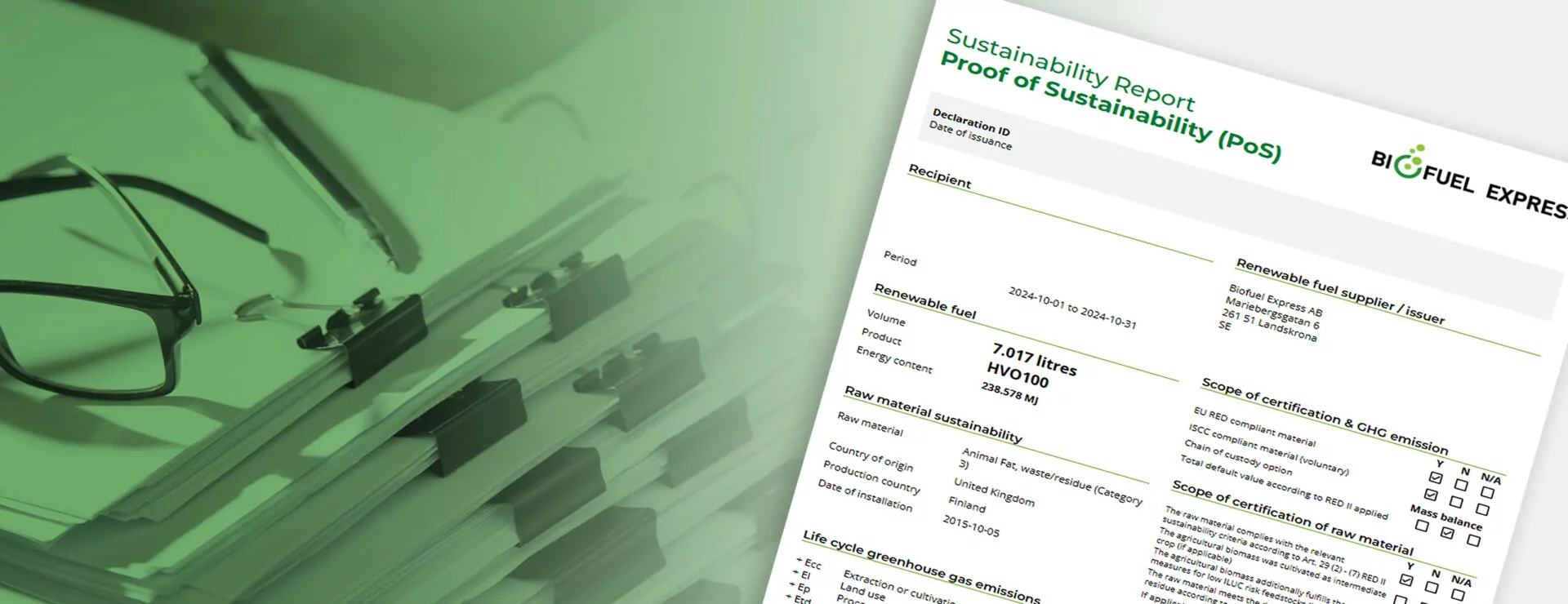
Our customer portal, Biofuel Express Insight, helps businesses measure and report CO₂ savings and keep the Proof of Sustainability for each delivery in one place.
"*" indicates required fields